

A staircase is often the most beautiful feature in a contemporary home — and, if there are small children around, the one that worries parents most. The good news is that safety and good design aren't opposites. A well-made spiral or modern staircase can be both striking to look at and genuinely safe for a young family, provided the right details are built in from the start rather than patched on afterwards.
This guide explains what actually makes a staircase child-safe, where the UK regulations come in, and how to keep a sleek modern look without cutting corners on safety.
Why Is Staircase Safety Important in Homes with Children?
Stairs are one of the most common places for accidents at home involving young children. Toddlers are drawn to climbing, gaps look like invitations, and open designs that feel airy to an adult can present hazards to a child who hasn't yet learned where the edges are. Designing with that in mind doesn't mean settling for a dull, boxed-in staircase — it means thinking carefully about spacing, surfaces and the points where curious hands and feet end up.
How to Design a Child-Safe Spiral Staircase
Spiral staircases carry a particular reputation for being tricky with children, mostly because of their tapering treads and open centre. In practice, a spiral stair can be made very child-friendly with the right design choices: a generous central column, treads that are deep enough to stand on confidently, and a balustrade that fully encloses the open side. The detail matters far more than the shape.
Balustrade Spacing and Height: UK Regulations
This is the single most important safety detail. Under Building Regulations Approved Document Part K, the gaps in a domestic balustrade must be small enough that a 100mm sphere cannot pass through — a measure designed specifically to stop a small child's head from becoming trapped. For most homes, the balustrade or handrail should also be at least 900mm high on the flight. On a spiral staircase, where the geometry curves, vertical balusters or glass infill both work well to keep within that 100mm rule along the whole run.
Non-Slip Treads and Open-Riser Precautions
Smooth timber or polished metal looks wonderful but can be slippery, especially in socks. Adding a subtle non-slip finish, a textured nosing or a tactile inlay to each tread reduces the risk of a fall without spoiling the look. Open-riser staircases — those with a gap between each step — need a second look in a family home: that gap also has to respect the 100mm rule, so risers may need partial infill or closer tread spacing where young children use the stairs.
Safe Design Details in Modern Staircases
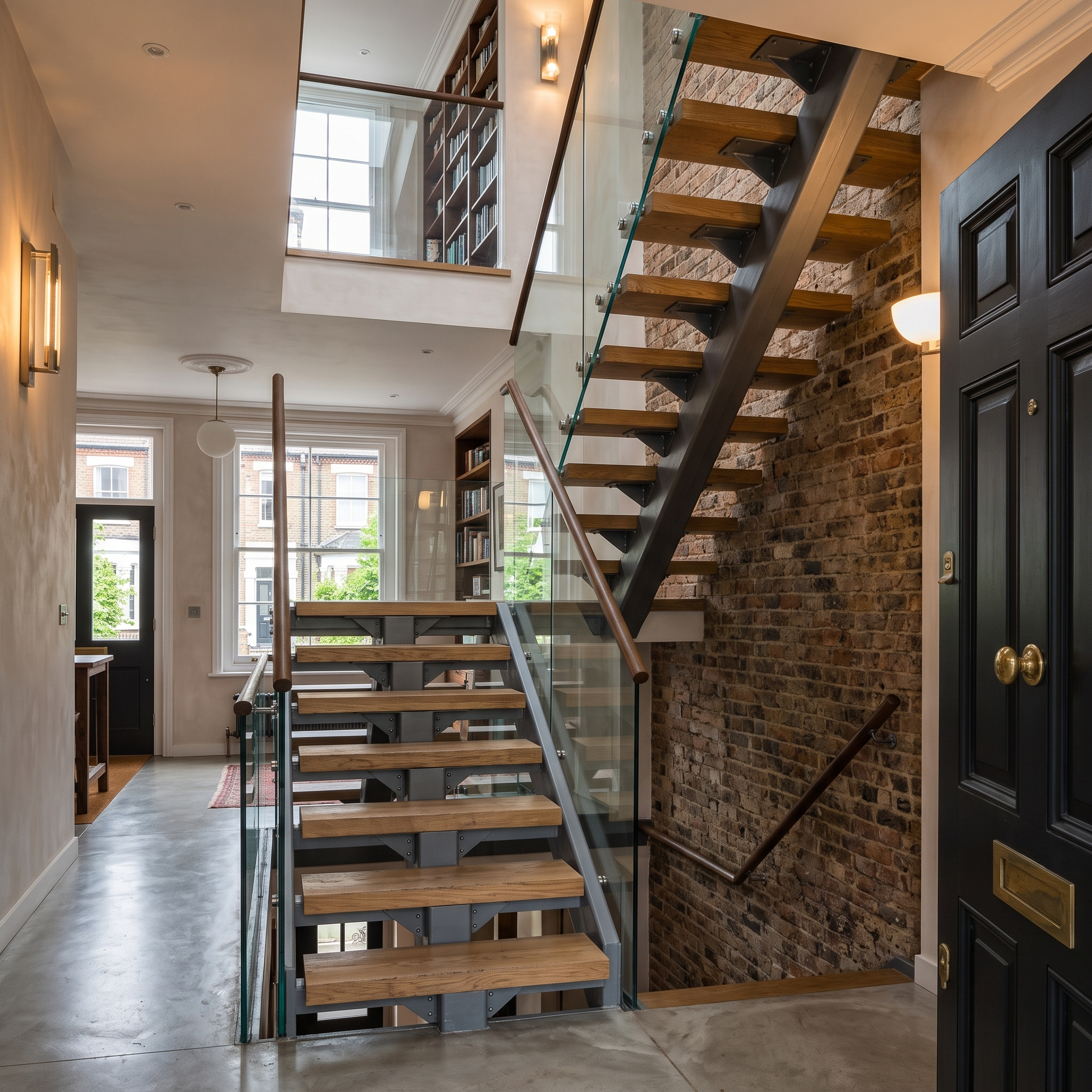
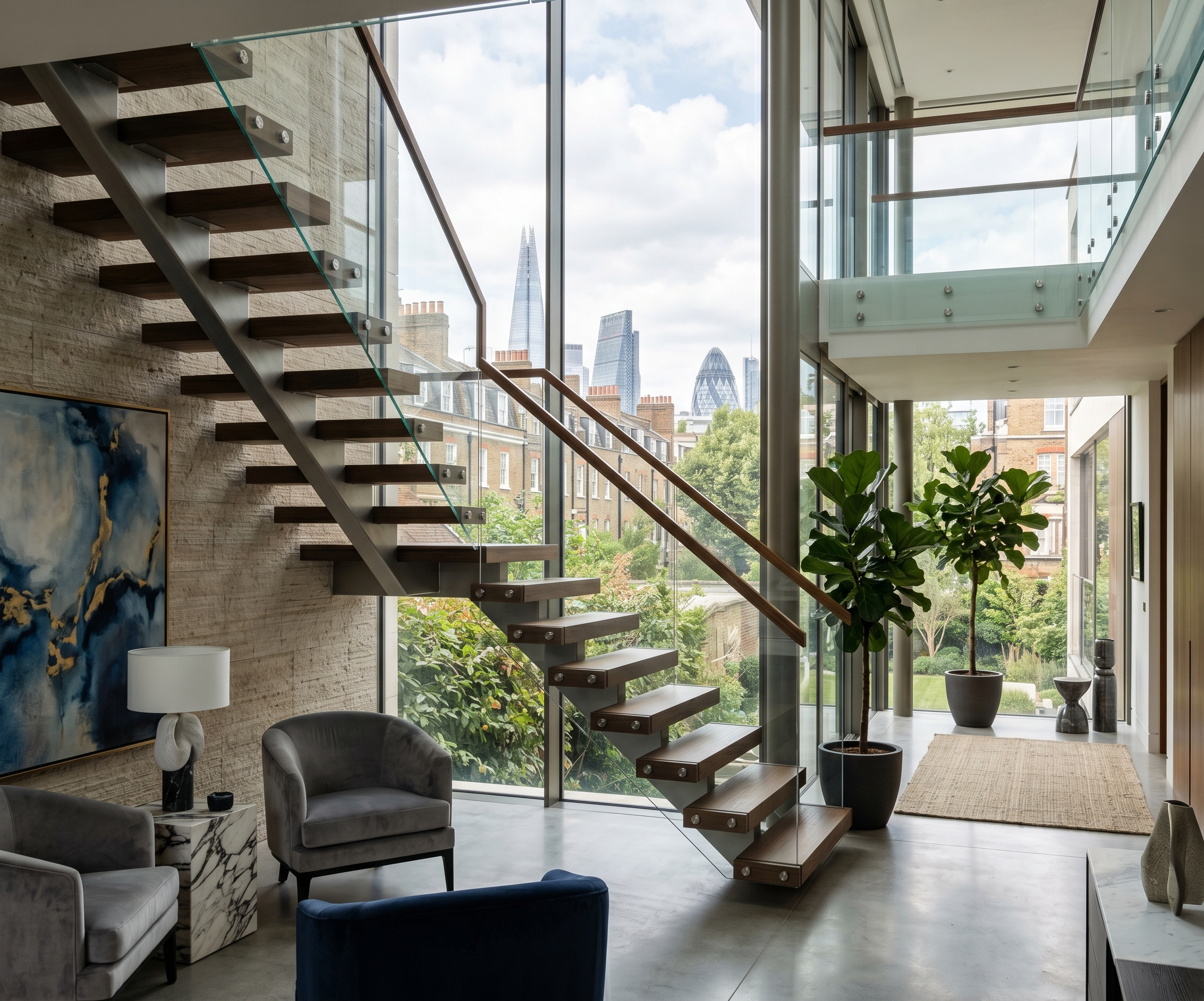
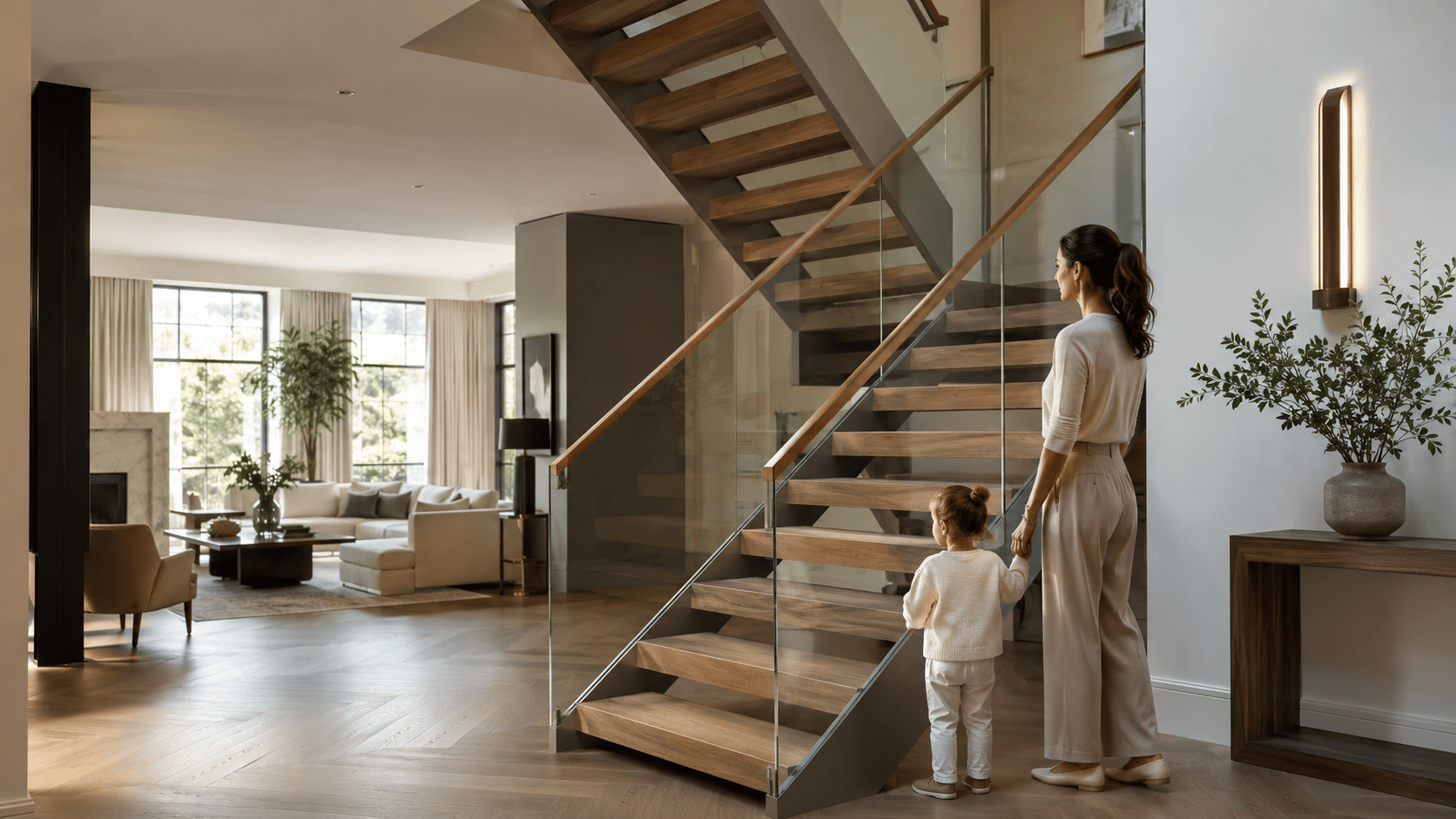
Modern straight, floating and spine staircases share the same priorities: enclosed balustrades, secure handrails and well-finished surfaces. Because these designs are bespoke, safety features can be designed in invisibly — a frameless glass balustrade, for instance, both meets the gap rule and lets light through, so you don't trade safety for openness. A continuous handrail at a child-reachable height, alongside the adult one, is another simple touch that makes a real difference.
Compatibility with Baby Safety Gates
Parents almost always want to fit a stair gate while children are very young, and modern staircases can make this awkward if it isn't planned for. A floating or spine staircase rarely offers an obvious post to clamp a pressure gate against, so it's worth discussing this at the design stage. A bespoke maker can build in a discreet fixing point, a flat newel face or a recessed wall fixing so a gate can be mounted securely and removed cleanly later, without damaging the staircase.
Combining Safety with Aesthetics
The best child-safe staircases don't announce themselves as “safe” — they simply work. Frameless glass keeps sightlines open while closing gaps. Warm timber treads with a barely-visible non-slip finish stay handsome and grippy. A handrail can be a sculptural feature as much as a safety device. Because every element is made to measure, there's no need to choose between a staircase that looks right and one that protects a young family; a good design delivers both at once.
Frequently Asked Questions
Which is safer for children: a floating or a spine staircase?
For a home with young children, both floating and spine staircases can be made fully safe — the difference is in the detail rather than the safety itself. Floating staircases with open treads need careful attention to riser gaps and a fully enclosing balustrade, while spine staircases offer a continuous central support that some parents find reassuring. Whichever you prefer, the safety comes from regulation-compliant balustrades, secure handrails and non-slip treads, all of which a bespoke maker designs in from the outset.
What should the balustrade spacing be?
In UK homes, the gaps in a staircase balustrade must be small enough that a 100mm sphere cannot pass through, in line with Building Regulations Part K. This applies to the gaps between balusters, between treads on open designs, and anywhere a child could otherwise slip through. Keeping every opening under 100mm is the core rule for a child-safe balustrade.
Studio Disoul – Safe, Bespoke Staircases
At Studio Disoul, we design and build bespoke spiral, floating and modern staircases for homes across London and the surrounding counties — including family homes where safety is a priority. Every staircase we make is engineered to comply fully with Building Regulations, with child-safe details considered from the first sketch. If you're planning a staircase for a home with children, get in touch and we'll help you achieve a design that's as safe as it is beautiful.